If you’ve ever watched a factory assembly line snap a robot arm into place, seen a dock door open smoothly, or spotted a packaging machine push a box shut in one quick, precise motion, odds are a pneumatic cylinder was behind that action. For years, I’ve worked directly with industrial operators, maintenance teams, and engineers who come to me with basic questions—this is the one that pops up more than any other: How does this seemingly simple metal tube turn compressed air into such reliable, consistent force? Let’s break it down, no confusing jargon, and I’ll tie in what I’ve learned from 10+ years supplying these cylinders to shops, factories, and custom fabricators. Pneumatic Cylinder
First, let’s start with the core parts of a pneumatic cylinder, because you can’t understand how it works without knowing what’s inside. I’ve seen too many new operators take these apart and be surprised how uncomplicated the design is—unlike hydraulics, which use messy oil, pneumatics rely only on air, so components are lighter, easier to maintain, and safer for food or electronics manufacturing. The main parts are: a barrel (usually aluminum or steel, to hold pressure without bending), a piston (the moveable disc that slides inside the barrel), a piston rod (the metal shaft that sticks out one end to attach to whatever needs moving), end caps (the sealed caps on both ends of the barrel, with ports for air to enter and exit), and seals (o-rings, rod seals, and wiper seals that keep air in and contaminants out). That’s it. No fancy electronics, no complex valves—just air and a sliding disc.
Now, the physics behind the power. This is where it gets basic, but it’s the reason pneumatic cylinders do their job. Compressed air—air that’s been pressurized from atmospheric pressure (roughly 14.7 psi at sea level) to anywhere from 60 to 150 psi for most industrial use—has a lot of stored energy. That energy is pressure, and pressure equals force times area. Let me put that in real numbers, because operators I work with care about this: if you have a 2-inch diameter piston, the area inside the barrel it pushes against is about 3.14 square inches (calculated as πr², so π times (1 inch radius) squared). Multiply that area by 100 psi of compressed air, and you get 314 pounds of force. That’s enough to lift a 50-pound engine block, push a 100-pound crate, or clamp a metal part tight for welding. No electricity needed here, which is a huge plus for workshops where power might be spotty, or for explosive environments where sparks from electric motors are a risk.
The working cycle itself is straightforward, and I walk new customers through this when they’re deciding which cylinder to order. Let’s use a standard double-acting cylinder, which is the most common type we supply (single-acting only has air going to one end, so it retracts with a spring, which is good for small, light loads, but double-acting lets you push and pull, which is 90% of what industrial uses need). Here’s the step-by-step:
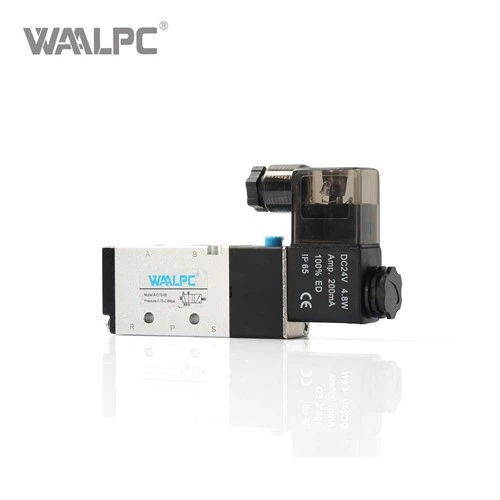
- A valve (usually a solenoid valve, controlled by a PLC or a manual switch) sends compressed air through the inlet port on the cap end—the end of the cylinder where the piston rod doesn’t come out. This air fills the chamber between the cap end and the piston, creating pressure on one side of the piston.
- That pressure pushes the piston away from the cap, which slides the piston rod out. The air that was on the other side of the piston (the rod end, where the rod sticks out) is pushed out through its exhaust port into the atmosphere. That’s the extend motion, and it continues until the piston hits the mechanical stop at the end of the barrel—so it extends exactly the length you specify when you order a cylinder, no overshooting if you size it right.
- To retract the piston, the valve reverses: it sends compressed air to the rod end inlet port, and the cap end air exhausts. Now pressure is on the side with the rod, pushing the piston back toward the cap end, pulling the rod in.
Wait, you might notice a small difference between extend and retract force— I always point this out because it’s a common question. The rod takes up a little space on the rod end, so the area there is slightly smaller than the cap end area. That means retract force is a tiny bit less than extend force, usually 5-10% for most standard cylinders. For heavy-duty jobs, that’s why we offer larger bore sizes—so even with that small loss, you still get the force you need.
Now, why does this work better than other actuation methods for so many jobs? I’ve had customers switch from hydraulics to pneumatics, or from electric actuators, and the reason always comes back to reliability and cost. Pneumatic cylinders don’t have oil leaks, which means no mess on factory floors, no contamination for food and beverage or pharmaceutical lines. They’re also way simpler to maintain—most maintenance is just checking the air filter, replacing a $2 o-ring every few years, and lubricating the rod occasionally, no complex servo motor calibrations. For small to medium production runs, they’re also cheaper to operate: compressed air is generated on-site, and when you’re not using the cylinder, air just vents to the atmosphere, so you don’t waste energy on holding position (unlike electric actuators, which draw power 24/7 to keep a load in place).
But there are limits, and I make sure every customer knows these when they reach out. Pneumatic cylinders can only generate so much force—if you need more than 10,000 pounds, you’ll need a hydraulic cylinder, because that would require a massive 12-inch bore pneumatic cylinder, which is unwieldy and expensive. They’re also not ideal for precise, slow positioning: if you need to move a load 1/16 of an inch at a time, electric actuators or servo motors are better, because air is compressible (that’s a feature, but it also means slight variations in speed or position if your air pressure fluctuates). For most industrial jobs—assembly, packaging, clamping, lifting light to medium loads—those limits don’t matter, which is why we sell thousands of these every year.
I’ve also seen a lot of misconceptions from people who think pneumatic cylinders are all the same. A customer last month came to me with a problem: his old cylinder was jamming every time he ran it at a 10-second cycle rate for his bakery’s dough presses. He’d bought a cheap off-brand cylinder, and the seals were low-quality, so they wore out fast, and the barrel wasn’t perfectly machined, so the piston was rubbing unevenly. We supplied a standard-duty aluminum cylinder with urethane seals, made for continuous high-cycle use, and he hasn’t had a problem since. That’s why I always tell people: the cylinder you buy matters more than the price tag. Cheap ones might work for a while, but they’ll fail when you need reliability most.
Another common question: how do you control the speed of a pneumatic cylinder? That’s where flow control valves come in, which we also supply. You can adjust the amount of air going into or out of each port, so if you want to slow the extend motion for a fragile part, you restrict the air on the cap end. For fast motion, you open the valve fully. That’s a simple adjustment, no programming or complex tuning needed, which is why operators love them.
Let me wrap this up with what I’ve learned over the years working with these cylinders. They’re one of the unsung heroes of industrial automation, used in every industry from auto manufacturing to food processing to logistics. Their working principle is deceptively simple: use compressed air’s pressure to move a piston, turn that into linear force, and exhaust the air when you’re done. But that simplicity is what makes them so versatile, reliable, and cost-effective.
If you’re working on a project and need a pneumatic cylinder that’s sized right, built to last, and tailored to your specific application—whether it’s a new assembly line, a replacement for a worn-out unit, or a custom solution for a unique job—reach out to discuss your requirements. We don’t just sell cylinders; we help you pick the right one for your load, cycle rate, and environment, so you get consistent performance without downtime.
Pneumatic Actuators References
- Pneumatic and Hydraulic Systems: Design and Operation, 2nd Edition, R.K. Bhandari, McGraw-Hill, 2019
- Industrial Pneumatics: Principles and Applications, J. Frank, Industrial Press, 2021
- Fluid Power Handbook, National Fluid Power Association, 2020
Hangzhou Evershine Pneumatic Import & Export Co., Ltd.
Hangzhou Evershine Pneumatic Import & Export Co., Ltd. is one of the most professional pneumatic cylinder manufacturers and suppliers in China, featured by high quality pneumatic components. Please rest assured to wholesale bulk durable pneumatic cylinder from our factory. Welcome to contact us for custom service and OEM service.
Address: Hengkun Smart Industrial Park, No.176, Golf Road, Yinhu Street, Fuyang District, Hangzhou City, Zhejiang Province, China 311400
E-mail: Felix@waalpc.com
WebSite: https://www.evspneu.com/
