If you’ve ever spent time on the floor of a manufacturing line, integrating a slide table into an automation cell, or troubleshooting a linear module that’s suddenly acting up, you know that one part fails more often than any other when it comes to linear motion systems: the ball screw. Over the years, I’ve heard every story of unexpected breakdown—from a packaging line that halted mid-shift, to a CNC router that would only move half its intended distance, to a medical device that missed its critical alignment mark for the 12th time that week. I run a company that supplies slide tables and linear modules, so I get called at 2 a.m. way too often for breakdowns like this. More often than not, when we dig into what went wrong with the ball screw, it’s not a manufacturing defect (we test every ball screw that goes out with our systems) or a cheap part from a no-name supplier. It’s something preventable, something that comes down to how the system’s being installed, maintained, or even operated day-to-day. Today, I want to walk through the most common reasons ball screws fail on slide tables, from the perspective of someone who’s seen hundreds of these issues. Slide Table and Linear Module
First, let’s start with something that’s easy to overlook: misalignment during installation. I can’t tell you how many slide tables I’ve seen come back to our shop where the ball screw and the motor shaft aren’t perfectly aligned. You might think “close enough” is fine, but ball screws are precision components built to micron-level tolerances. Even a tiny angular misalignment—like a 0.005-inch offset that’s barely visible to the naked eye—creates side loads on the screw’s bearings, the nut, and the balls inside. Over time, that extra stress causes the screw’s threads to wear unevenly. The balls don’t roll smoothly anymore; they start to scrape, create micro-wear, and eventually, flake off small pieces of material. That debris gets trapped inside the nut, turning the entire ball screw assembly into a grinding mechanism instead of a smooth linear driver. The worst part? This kind of misalignment doesn’t show up right away. It might take weeks or even months for the wear to become bad enough that the slide table starts jittering or stops moving entirely. I always remind customers that even if they use a flexible coupling (which they should, by the way), they still need to verify alignment with a dial indicator during installation. It’s a 10-minute step that can save thousands in downtime.
Next up, insufficient lubrication—or using the wrong kind of lubricant. Ball screws rely on lubrication for two main jobs: reducing friction between the balls and the threads, and flushing away debris that builds up from normal wear. I’ve seen both extremes: a customer who never lubricated a new slide table and ran it 24/7 for three months, and another who over-greased the assembly with a thick, high-viscosity grease meant for heavy-duty industrial machinery, not for a precision ball screw. Both scenarios lead to failure. If there’s not enough lubricant, metal-on-metal contact happens. The balls and threads don’t roll—they grind against each other, leading to accelerated wear and premature failure. For linear modules, which often have ball screws that run at higher speeds and under lighter loads, the lubricant needs to be thin enough to get into all the small gaps between the components, but thick enough to stay in place and provide a protective film. On the flip side, too much grease creates excess heat. The extra friction from the thick, stagnant grease causes the screw and nut to overheat, which can warp the screw over time. Warping is a big problem because it throws off the screw’s pitch accuracy, making the slide table move inconsistent distances. I once had a customer who followed our manual to the letter, but used a grease from their plant’s stock that wasn’t the type we recommended. Their ball screw failed in half the expected lifespan. Always use the lubricant we specify for your linear module—we test different types for each application, so we know what works.
Contamination is another huge culprit, especially in industrial environments where slide tables are exposed to dust, metal shavings, food particles, or even water. Let’s be real: not every manufacturing facility is a cleanroom. A lot of slide tables go into places like woodworking shops, plastic injection molding lines, or packaging plants where there’s debris everywhere. If the ball screw’s protective bellows or seals are damaged, or if they’re not even installed at all, that debris can get into the nut. Once it’s inside, it acts like sandpaper. The hard particles scratch the threads, damage the ball surfaces, and create more debris as they wear down. I worked with a customer who put a slide table into a metal stamping line without adding a bellows. After two weeks, the ball screw was full of tiny steel shavings, and the nut was so worn that the slide table had 2mm of backlash—way beyond our acceptable limit. Even small amounts of dust from sanding can do this over time. Seals and bellows aren’t just add-ons; they’re critical parts of protecting the ball screw. If a seal gets damaged during installation, replace it immediately. Don’t wait until it’s too late.
Then there’s overloading the slide table or linear module. Every ball screw has a rated dynamic load, the maximum amount of force it can handle over its expected lifespan. If you push past that, the ball screw will fail prematurely. I’ve seen this happen when customers use a slide table designed for light assembly work in an application that requires moving heavy parts, like a stamping press or a large material handling cart. Sometimes it’s accidental—they thought the slide table could handle more weight, or they added a custom tool to the end that wasn’t factored into the load calculation. Overloading creates excessive stress on the screw’s threads and the balls, leading to what’s called brinelling, where small indentations form on the ball and race surfaces. Those indentations make the balls roll unevenly, causing noise, backlash, and eventually, total failure of the assembly. Even short periods of overloading can cause permanent damage. I always tell customers to reach out to our team before modifying a slide table or linear module for a new application. We can help them calculate the load requirements and choose the right size ball screw to avoid this kind of failure.
Another issue that’s less talked about but still common is improper mounting of the ball screw’s end bearings. The end bearings support the ball screw and keep it aligned as it rotates. If they’re not mounted correctly—too tight, too loose, or not aligned with the screw’s axis—they create extra stress on the entire assembly. For example, if an end bearing is adjusted too tight, it puts pressure on the screw, causing it to bend or warp over time. That warp leads to uneven load distribution on the balls, so some balls carry more weight than they should, wearing out faster. If the bearing is too loose, the screw can wobble as it rotates, leading to misalignment, backlash, and accelerated wear on the nut and threads. I’ve had customers come to us with a noisy slide table, and when we check the end bearings, we find they were assembled with a wrench that was too big, over-tightening the bearing bolts. It’s a simple mistake, but it’s one that leads to a lot of avoidable breakdowns. Always follow the torque specifications in our installation manual for end bearings, and use a torque wrench—don’t guess.
Finally, wear and tear from regular operation without maintenance. Even if you have the perfect installation, the right lubricant, no contamination, and the correct load, ball screws will wear out eventually. That’s why regular maintenance is so important. Over time, lubricant breaks down, seals wear out, and minor contamination can build up even in the best systems. Skipping routine checks means you’ll miss early signs of wear—like increased noise, backlash, or inconsistent movement—until the ball screw fails completely. I recommend a monthly inspection for most linear modules: check the lubricant level, look for damage to seals or bellows, listen for any unusual noise when the slide table moves, and verify alignment. For high-cycle applications (like a slide table moving 100 times a minute), you might want to do these checks every two weeks. It takes a little time, but it’s way cheaper than replacing a whole ball screw or dealing with unplanned downtime.
Here’s the thing I want customers to remember: most ball screw failures on slide tables and linear modules aren’t due to defective parts. They’re due to small, preventable mistakes in installation, maintenance, or operation. After 15 years in this business, I’ve seen it all, and the worst calls are the ones that could have been avoided with a little attention to detail. If you’re dealing with a slide table that’s having ball screw issues, or if you’re designing a new system and want to make sure you choose the right ball screw and set it up correctly, our team is here to help. We don’t just supply parts—we work with you through every step, from selection to installation guidance to maintenance tips. We understand that downtime costs you money, so let’s make sure it doesn’t have to be due to a ball screw failure. Reach out to us anytime to discuss your application, ask questions, or find the right linear motion solution for your needs.
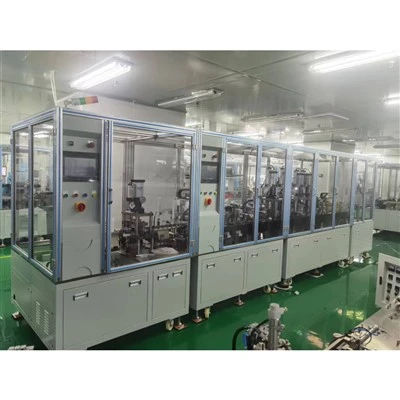
Automotive Relay Production Line References
- Bolton, W. (2015). Mechatronics: Electronic Control Systems in Mechanical and Electrical Engineering. Pearson Education Limited.
- Shigley, J. E., & Mischke, C. R. (2004). Standard Handbook of Machine Design (3rd ed.). McGraw-Hill.
- Hunter, J. L., & Kurz, J. M. (2019). Linear Motion Systems: Design, Selection, and Application. SME.
- American Society of Mechanical Engineers. (2017). ASME B106.1M-2017: Design for Linear Motion Guideway and Ball Screw Systems. ASME International.
- Halliday, D., Resnick, R., & Walker, J. (2021). Fundamentals of Physics (12th ed.). Wiley.
Yangning (Xiamen) Intelligent Technology Co., Ltd.
With abundant experience, we are one of the most professional slide table and linear module manufacturers in China. As we have world-leading production equipment and strong manufacturing capabilities, we warmly welcome you to buy bulk advanced slide table and linear module from our factory. Customized orders are welcome.
Address: Room 307-2, No. 15 Duiying Road, Software Park Phase III, Torch Hi-Tech Zone, Xiamen, Fujian, China
E-mail: mia@ynautos.com
WebSite: https://www.ynautos.com/
